
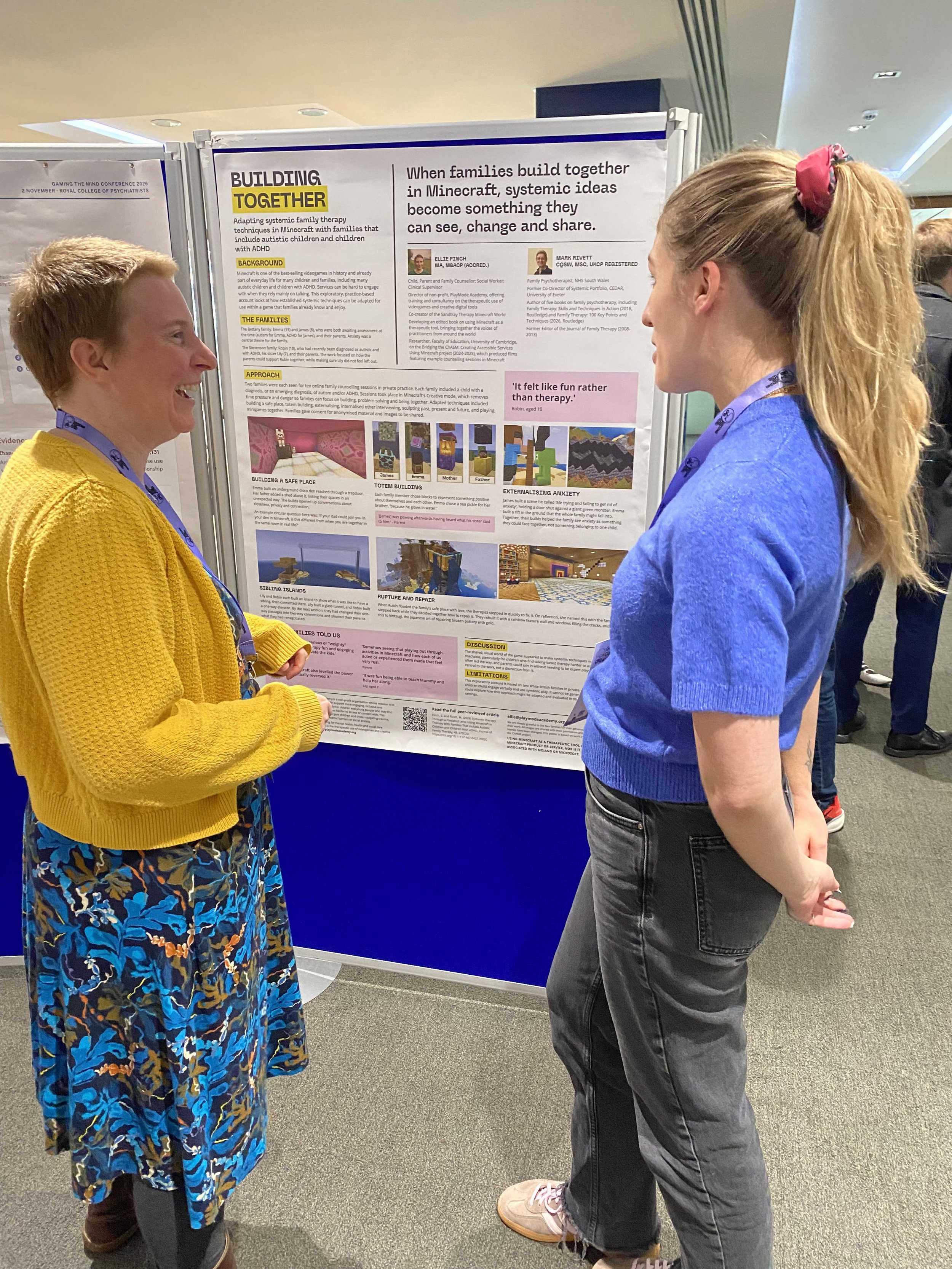
I had a research poster at the Gaming the Mind conference this week at the Royal College of Psychiatrists. I shared my work going into Minecraft with families during family counselling sessions, and how established systemic family therapy techniques can be adapted for use within a game that families already know and enjoy.
The poster includes some key moments from the work. In a strengths-focused totem-building activity, Emma (15) chose a sea pickle to represent her younger brother, James (8), because he glows in water. Lily (7) and Robin (10) each built an island to show what it was like to have a sibling, then joined the islands together. By the next session, they had turned their one-way passages into two-way connections.
The conference opened with a focus on three really different games. Hellblade Senua’s Sacrifice by Ninja Theory gives you a visceral sense of what it can be like to experience psychosis. Vampire Therapist by Little Bat Games brings ideas from cognitive behavioural therapy into play in a way that is fun and really unique. Lost Words by Sketchbook games offers a really immersive way into understanding grief. Each one is a brilliant game in its own right, and the understanding it offers about mental health comes through the experience of playing it.
That felt close to the work behind my poster, where the therapeutic work happened through families playing together in Minecraft. One child said it felt like fun rather than therapy. A parent said it helped motivate the kids with a topic that could feel serious or weighty. When Mark Rivett and I wrote our peer-reviewed article, we came to see shared fun as central to the work, not a distraction from it.
At the end of the conference, Rachel Addley from OKRE spoke about the Video Games Impacts framework they have developed with Ukie for understanding the social and economic impacts of video games, including on health and wellbeing. It connects with some work I’ve been doing on the Sandtray Therapy World, a free Minecraft world I created with Dan Noble of Outsidetheblocks. It recreates a therapy room inside Minecraft, with a sandtray and shelves of figures for therapeutic play and storytelling. With training from Costello Medical, I’ve been thinking about how we understand and measure the Sandtray Therapy World’s impact. It’s early days, but I’m excited about it.
Thank you to Gaming the Mind for such a thoughtful conference, and to everyone I met. It was lovely to spend time with so many people who care this much about games and the people who play them.
You can view the poster here, and read the full article in the Journal of Family Therapy here.
