What Games for Change London reminded me about why parents need to step into their children's digital worlds
Earlier this month I attended Games for Change in London, and I've been thinking about it ever since.
There was a lot that stayed with me. But I want to start with Robert Steen, who spoke about his son Mats, who had a life-limiting condition. After Mats died, Robert discovered at the funeral that his son had built a whole social world for himself inside World of Warcraft - friends who knew him, cared about him, and showed up to say goodbye. Robert's regret was that he hadn't known about this while Mats was alive, and that he might have been able to connect with him in the game and known this rich part of his life.
A documentary was made about Mats’ digital life - The Remarkable Life of Ibelin - and I'd encourage you to watch it if you haven’t already. Hearing Robert talk was an emotional moment for me. I have a daughter with a life-limiting condition, and the idea that a parent might not know about a whole dimension of their child's life - and only discover it when it's too late - sits close to home. I also spend a lot of my working life as a child and family counsellor encouraging parents to step into their children's digital worlds, and supporting therapists to meet young people in the videogames they already love like Minecraft and Roblox through my non-profit PlayMode Academy. Robert's story is exactly why that work matters to me.
The rest of the day was full of conversations I'll be thinking about for a while:
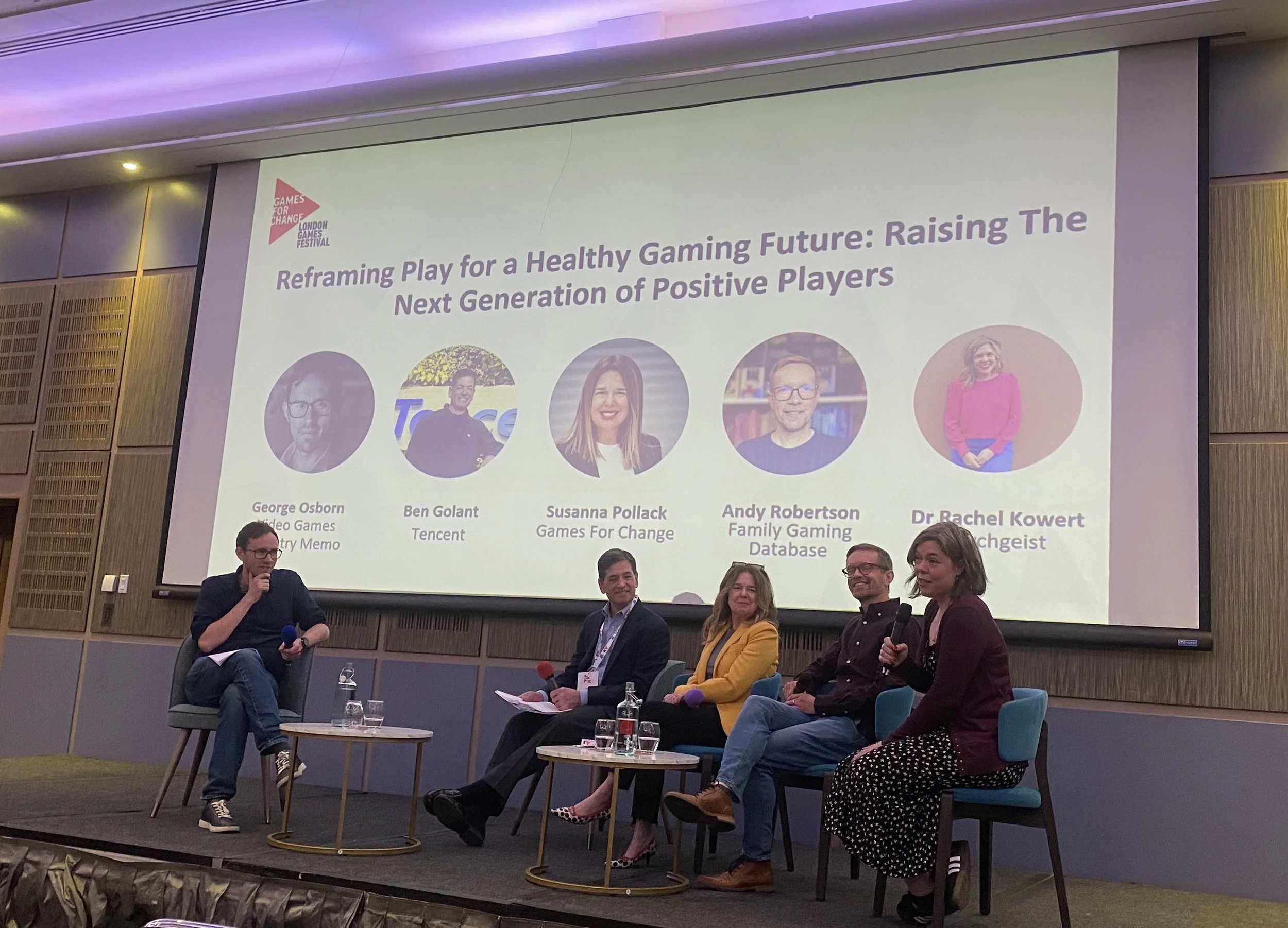
A panel on how the games industry can better support parents hosted by George Osborn (who curated this amazing event!) with Ben Golant, Susanna Pollack, Andy Robertson and Dr Rachel Kowert. A roundtable on crafting safer gaming communities led by Galen Lamphere-Englund and Rachel Kowert.
A session on how games can yield positive social change through encouraging prosocial behaviour - empathy, altruism and collective problem solving - with Matt Vernon-Clinch, Laura Higgins, Ben Cowley, Shuli Gilutz and Anna Rafferty.
A panel on how video games can meaningfully shape the real world - its cities, its communities, and the ways people imagine their futures - hosted by Lord Gascoigne with James Delaney, Nissa Shahid, Amy Jenkins Le Gerroue, James Golding and Tess McCann.
I also had the opportunity to chat with Shuli Gilutz and Allisyn Levy about UNICEF’s RITEC Design Toolbox for designing games for Children’s Well-being. Do check out their resources here: https://www.unicef.org/childrightsandbusiness/workstreams/responsible-technology/online-gaming/ritec-design-toolbox
It was great to see Justin Edwards from Minecraft Education, who features in the AHRC funded University of Cambridge films I co-created with Monique Beckett: https://www.educ.cam.ac.uk/research/programmes/chasm/
I was so happy to get to catch up with Stephen Reid from Endless who have been creating the incredible open-source game Threadbare – a game and a learning platform woven together: https://access.endlessstudios.com/games/threadbare
I also met Bayan Mashat who told me a story I will never forget and who has created a beautiful game with Blue Tango Street called Sips and Sonnets: https://store.steampowered.com/app/3176190/Sips_and_Sonnets/
And Nicola Clarke kindly gave me a copy of Into Film’s Games Story Builder which is such a fantastic resource for supporting young game developers and available for free here: https://www.intofilm.org/resources/2072
I’m so grateful I got to be there and I’m really looking forward to the next Games for Change London. Thank you to everyone who made it happen!